Shell and tube heat exchanger selection guide
Guide last reviewed: 9 June 2026
Heat exchanger configuration selection
Answer a short set of questions about your service and the calculator recommends a TEMA configuration to take into your Request for Quotation.
Choose your configuration
In short. Three questions about your service drive the configuration choice. Four configuration families answer them. This guide walks through each family and the trade-offs that follow.
Shell and tube heat exchanger selection is the configuration choice an engineer or estimator makes before sending a Request for Quotation. Three questions drive the choice. Four configuration families answer them. The rest of this guide walks through each family and the trade-offs that follow.
In this guide
- How a shell and tube heat exchanger works
- The three questions that drive the choice
- Cleaning and maintenance access
- Fixed tubesheet exchangers (BEM and AEN)
- U-tube exchangers (BEU and AEU)
- Floating head exchangers (BEW and AEW)
- Kettle reboilers (BKU)
- Materials and when each one is right
- Configuration by application
- How Britannia Jahco engineers and builds your exchanger
- Common configuration-selection mistakes
- When a shell and tube exchanger is not the right answer
- FAQ
- Request a quote
How a shell and tube heat exchanger works
In short. Two fluids flow on opposite sides of a metal tube wall. Heat moves through the wall by conduction. Seven main parts make up the assembly, and a three-letter TEMA code names every configuration.
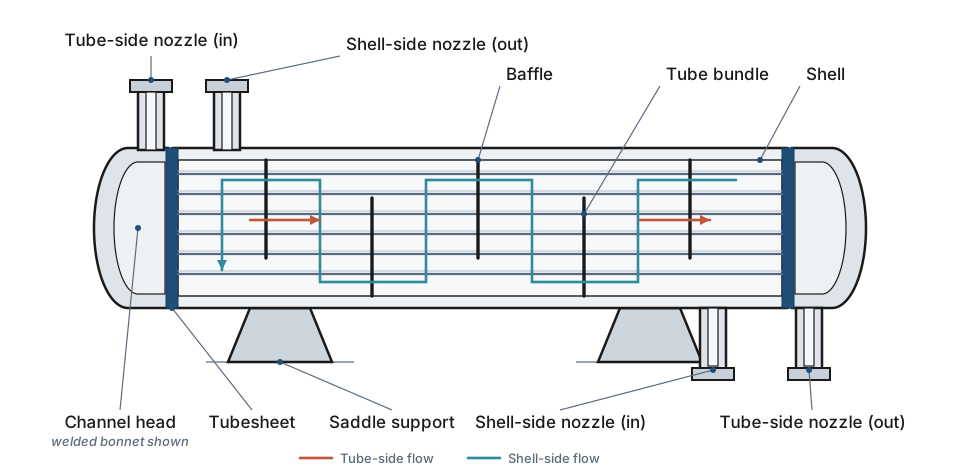
A shell and tube heat exchanger is a device that transfers heat between two fluids flowing on opposite sides of a metal tube wall. One fluid runs through the inside of the tubes. The other flows around the outside of the tubes inside a sealed shell. The tube wall keeps the fluids separated. Heat moves through the wall by conduction, driven by the temperature difference between the two streams.
The mechanical assembly has seven main parts:
- the shell, a pressure vessel that holds the bundle and contains the shell-side fluid
- the tube bundle, a parallel array of tubes that carries the tube-side fluid
- the tubesheets, plates at each end that seal the tubes into the shell-side pressure envelope
- the channel heads, covers at each end of the shell that direct the tube-side fluid into and out of the bundle
- the baffles, internal plates that direct shell-side flow across the bundle and support the tubes
- the nozzles, inlet and outlet connections for both fluids
- the saddle supports, external structural mounts that carry the shell weight
TEMA letter glossary
In short. The TEMA code is three letters: front head, shell type, rear head. Seven codes appear in this guide.
The TEMA letter system is a three-letter code that names the front head, the shell type, and the rear head of every shell and tube exchanger. The Tubular Exchanger Manufacturers Association maintains the system as the industry standard. The letters that appear in this guide break down by position.
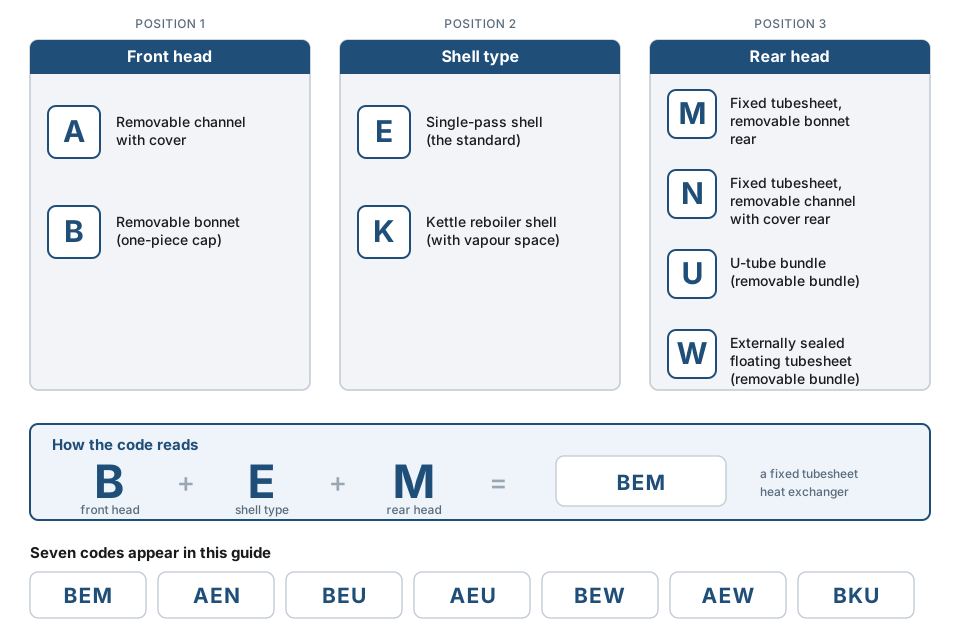
Front head, two letters:
- A, removable channel cover, bolted to the channel through a flange and gasket
- B, welded bonnet, integral to the channel
Shell type, two letters:
- E, single-pass shell, the standard for most configurations
- K, kettle reboiler shell with vapour space, paired with U-tube bundles in kettle reboilers
Rear head, four letters:
- M, fixed tubesheet with a bolted bonnet
- N, fixed tubesheet with a removable cover
- U, U-tube bundle
- W, externally sealed floating tubesheet
Seven codes appear in this guide. Each one combines a front-head letter, a shell letter, and a rear-head letter:
- BEM, AEN, BEU, AEU, BEW, AEW, BKU
The configuration sections that follow walk through each code.
The three questions that drive the choice
In short. Fouling, cleaning access, and pressure drop. Answer all three and you are left with a shortlist from the four-family set. The fouling matrix below is the fastest route to a recommendation.
Configuration selection for a shell and tube heat exchanger turns on three questions about the service:
- how fouling is each fluid
- what cleaning the unit requires
- how much tube-side pressure drop is acceptable
The answers leave a shortlist of suitable configurations from the four-family set. The fouling assessment table later in this section shows how the trade-off plays out.
The fouling assessment table
The fouling assessment table maps tube-side and shell-side fouling levels to the TEMA configurations that suit each combination.
| Fouling Level | Shell Low | Shell Med | Shell High |
|---|---|---|---|
| Tubes Low | BEU | BEU or BEM | BEU or BEW |
| Tubes Med | BEU or BEM | BEU or BEM | BEU or BEW |
| Tubes High | BEM or AEN | BEM or AEN or BEW or AEW | BEW or AEW |
Three observations follow:
- BEU dominates the clean and moderate-fouling cells, because it accommodates thermal expansion at a lower cost than a floating head
- Floating head configurations (BEW, AEW) become necessary when both fluids foul heavily, because no other configuration supports mechanical cleaning on both sides
- Fixed tubesheet configurations (BEM, AEN) appear where tube-side fouling is high but shell-side fouling is low, because they support tube-interior cleaning while the bundle stays welded to the shell
The cleaning access and pressure drop questions then refine the shortlist. Where the table above leaves more than one configuration, the cleaning access answers narrow the choice further. The cost hierarchy in the configuration summary tables then settles the call between near-equivalent options.
Kettle reboilers as a separate decision branch
A kettle reboiler (BKU) is a phase-change exchanger that is not included in the fouling assessment, because its service involves boiling or vaporising rather than the sensible-heat duties the table covers. If the service involves boiling or vaporising a shell-side fluid, a kettle is the right family. The fouling assessment does not apply. The kettle reboilers section covers the kettle reboiler decision in detail.
Cleaning and maintenance access
In short. Cleaning access is the primary decision axis. Four methods exist, each makes a specific demand on the exchanger geometry, and the wrong configuration makes the method the service needs impossible.
Cleaning access is the primary decision axis in configuration choice. Each cleaning method makes a specific physical demand on the exchanger, and the configuration must match the demand. Choose the wrong configuration and the cleaning method the service needs becomes impossible to apply.
Engineers clean shell and tube exchangers using three methods:
- hydroblasting
- chemical cleaning
- mechanical tube cleaning
Why cleaning access drives the configuration choice
Cleaning access drives configuration choice because each cleaning method needs a specific exchanger geometry. The four methods map onto the configurations as follows.
| Cleaning method | Configurations that support it |
|---|---|
| Hydroblasting, tube interior | BEM (with pipework disconnect), AEN, BEW, AEW |
| Hydroblasting, shell side | BEU, AEU, BEW, AEW (any removable-bundle configuration) |
| Chemical cleaning, all | All seven (BEM, AEN, BEU, AEU, BEW, AEW, BKU) |
| Mechanical tube cleaning | BEM (with pipework disconnect), AEN, BEW, AEW. Straight-tube configurations only. |
| Online cleaning | All seven, with system add-ons |
Three selection rules follow from the table:
- a service that needs mechanical tube cleaning rules out BEU and AEU
- a service that needs shell-side mechanical cleaning rules out BEM and AEN
- a service that needs both rules the design into floating head BEW or AEW
These three rules sit at the heart of the configuration choice and reappear in the configuration sections below.
The four cleaning methods in detail
Fixed tubesheet exchangers (BEM and AEN)
In short. Both tubesheets are welded to the shell, so the bundle is part of the pressure envelope. Simplest and cheapest construction. Right for clean, non-fouling services with modest temperature differential.
A fixed tubesheet exchanger is a shell and tube heat exchanger with both tubesheets welded directly to the shell. The bundle is part of the pressure envelope, not a removable assembly. That construction is usually the simplest and cheapest way to build a shell and tube heat exchanger.
It is the right answer when:
- both fluids are clean and non-fouling
- the temperature differential between shell and tubes is modest
- bundle replacement is unlikely during the design life
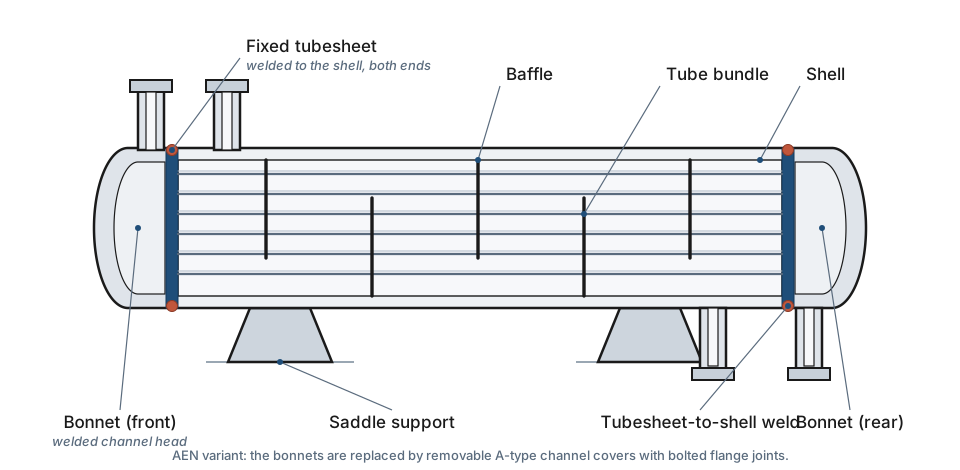
Two configurations from the calculator fall in this family: BEM and AEN. They share the same fixed-bundle construction and differ only in how you reach the tube interior for inspection or cleaning.
Fixed tubesheet with bonnet ends (TEMA: BEM)
BEM is a TEMA configuration code for a fixed tubesheet exchanger that combines:
- removable front and rear bonnets
- a single-pass shell
- a fixed tubesheet at the rear
The bonnet head bolts to the tubesheet but cannot come off without breaking the pipework connections. Tube-interior access takes three actions:
- disconnect the inlet and outlet pipework
- unbolt the bonnet
- lift the head clear
That intervention is acceptable in services where it only has to happen rarely over the design life.
Choose BEM when
- both fluids run clean. The tube interior and the shell side stay reasonably clean over the design life.
- frequent tube-interior cleaning is not part of the maintenance plan.
- the temperature differential between shell and tube fluids stays within the limit the tubesheet-to-shell weld can absorb. Industry guidance gives a representative threshold of around 50 degC. Above 50 degC the design needs an expansion bellows in the shell or a different configuration.
- capital cost is the primary constraint and the service allows it.
Avoid BEM when
- either fluid will foul during operation.
- the shell side will need periodic mechanical cleaning. A fixed bundle blocks shell-side access.
- the temperature differential will exceed 50 degC and bellows failure is a serviceability risk in remote or high-vibration locations.
- tube bundle replacement may be needed during the design life. Replacing the bundle on a BEM unit means scrapping the whole exchanger.
Fixed tubesheet with removable channel cover (TEMA: AEN)
AEN is a TEMA configuration code for a fixed tubesheet exchanger with a removable A-type channel cover at the front, secured by a flange and gasket. The cover unbolts to expose the front face of the tubesheet, so the tube interior opens for cleaning without disconnecting the pipework or cutting any joint. A maintenance team can rod or pig the tubes in place.
For the engineer specifying the unit, AEN opens a route to tube-interior cleaning without the disruption of a full disassembly. Useful when the tube-side fluid fouls moderately and periodic cleaning is part of the plan, but the shell side stays clean and the bundle does not need to come out.
Choose AEN when
- the tube-side fluid is moderate fouling. Tube-interior mechanical cleaning is expected during the design life.
- the shell side is clean. No need to reach the shell interior.
- tube bundle replacement is unlikely.
- the temperature differential stays within the same 50 degC threshold described for BEM.
Avoid AEN when
- the shell side will foul. The fixed bundle blocks shell-side access.
- the service justifies the cost of a removable bundle (U-tube or floating head).
Configuration summary table: fixed tubesheet
The fixed tubesheet summary table compares BEM and AEN attribute by attribute.
| Attribute | BEM | AEN |
|---|---|---|
| Tube interior cleaning | Pipework disconnect required | In-place via removable cover |
| Shell-side cleaning | Shell -side can only be cleaned by flushing or chemical cleaning | Shell -side can only be cleaned by flushing or chemical cleaning |
| Bundle replacement | Not without scrapping the unit | Not without scrapping the unit |
| Thermal expansion limit | Bellows-free up to a representative 50 degC differential | Same as BEM |
| Relative cost | Generally lower cost than BEW | Generally lower cost than BEW plus removable-cover premium |
| Typical services | Clean water cooling, light hydrocarbon services, utility duties with low temperature differential | Same as BEM, where tube-interior fouling is expected |
Britannia Jahco designs, fabricates, installs, and hydrostatically tests fixed tubesheet heat exchangers. Talk to the team about a fixed tubesheet exchanger for your service.
Project example. Britannia Jahco fabricated a fixed tubesheet AES unit for the Exxon KMR project, an example of the company fixed tubesheet capability in oil and gas service.
U-tube exchangers (BEU and AEU)
In short. Tubes are bent into a U at the rear, fixed at one tubesheet only. The bundle pulls out for shell-side cleaning, but the U-bends block mechanical tube-interior cleaning. No thermal expansion limit.
A U-tube exchanger is a shell and tube heat exchanger with a single tubesheet and tubes bent into a U-shape at the rear. Each tube fixes only at the front tubesheet. The U-bend at the rear is unconstrained, so the bundle expands and contracts axially without stressing the tubesheet-to-shell joint. That construction removes the temperature-differential limit that constrains fixed tubesheet designs.
The bundle is removable. Pull the front tubesheet and the entire bundle slides out of the shell, opening the shell side for mechanical cleaning. The trade-off is on the tube interior. The U-bends prevent mechanical rodding or pigging, so internal cleaning of the tubes is restricted to chemical methods or high-velocity flushing.
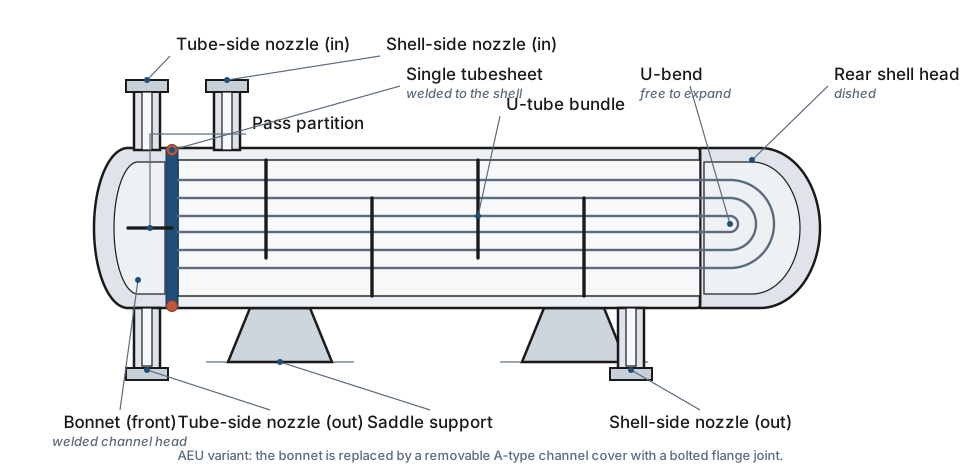
Two configurations from the calculator apply: BEU and AEU.
U-tube with bonnet ends (TEMA: BEU)
BEU is a TEMA configuration code for a U-tube exchanger that combines:
- a removable bolted bonnet
- a single-pass shell
- a removable U-tube bundle
To reach the tube ends or to remove the bundle, the operator unbolts the front bonnet and disconnects the pipework. Mechanical tools cannot reach the U-bends at the rear under any access scenario.
Choose BEU when
- the shell-side fluid is moderate or heavy fouling. The tube-side fluid is clean.
- thermal expansion is significant. The U-bundle accommodates differential expansion without bellows.
- bundle removal for shell-side mechanical cleaning is expected.
- cost is a constraint and the tube-side fluid never needs internal mechanical cleaning.
Avoid BEU when
- the tube-side fluid fouls and will need mechanical cleaning. U-bends block rodding and pigging.
- tube-side pressure drop must be minimised. BEU runs a minimum of two tube passes by geometry, one pass forward and one pass back through the U-bend. Single-pass tube-side hydraulics are not available in a U-tube design.
U-tube with removable channel cover (TEMA: AEU)
AEU is a TEMA configuration code for a U-tube exchanger with a removable A-type channel cover at the front. The cover unbolts to expose the front face of the U-tube bundle without disconnecting the pipework, which makes three front-end activities possible:
- inspection of the open tube ends
- plugging of individual leaking tubes
- chemical injection for in-place cleaning
Mechanical cleaning cannot reach the U-bends at the rear, the same constraint that applies to BEU. AEU is recommended when a U-tube design fits the service and routine front-end access is needed but full bundle removal is rare.
Choose AEU when
- the service fits a U-tube. Shell-side fouling, significant thermal expansion.
- the maintenance plan includes periodic front-end inspection or selective tube plugging.
- the pipework run prevents quick disconnection. The removable cover avoids touching the pipework.
Avoid AEU when
- tube-interior mechanical cleaning is required. AEU does not solve the U-bend cleaning constraint.
- cost sensitivity is severe. AEU carries a small premium over BEU for the removable cover.
Configuration summary table: U-tube
The U-tube summary table compares BEU and AEU attribute by attribute.
| Attribute | BEU | AEU |
|---|---|---|
| Tube interior cleaning | Pipework disconnect for front access. U-bends not mechanically cleanable. | In-place front access. U-bends not mechanically cleanable. |
| Shell-side cleaning | Bundle removable, full shell access | Bundle removable, full shell access |
| Bundle replacement | Bundle can be pulled and replaced | Bundle can be pulled and replaced |
| Thermal expansion | Accommodated by the U-bend, unlimited within material limits | Same as BEU |
| Tube passes | Minimum two by geometry | Minimum two by geometry |
| Relative cost | Generally lower cost than fixed tubesheet option | Generally lower cost than fixed tubesheet option plus removable cover premium |
| Typical services | Refrigeration evaporators, condenser duties, high-pressure steam, light hydrocarbon services | As BEU, where regular front-end inspection is expected |
Britannia Jahco designs, fabricates, installs, and tests U-tube heat exchangers. Talk to the team about a U-tube exchanger for your service.
Project example. Britannia Jahco built a BEU exchanger for Supagas in a CO2 and water service, fabricated in stainless steel 316, an example of the company U-tube capability.
Floating head exchangers (BEW and AEW)
In short. One tubesheet fixed, one free to move axially inside the shell. The only configuration that supports mechanical cleaning on both sides. Cost premium around 25 percent over fixed tubesheet.
A floating head exchanger is a shell and tube heat exchanger with one fixed tubesheet and one tubesheet free to move axially inside the shell. A packed gland or an internal cover seals the floating end against the shell. The construction accommodates thermal expansion without U-bends and gives complete access to both the tube interior and the shell side once the bundle is removed.
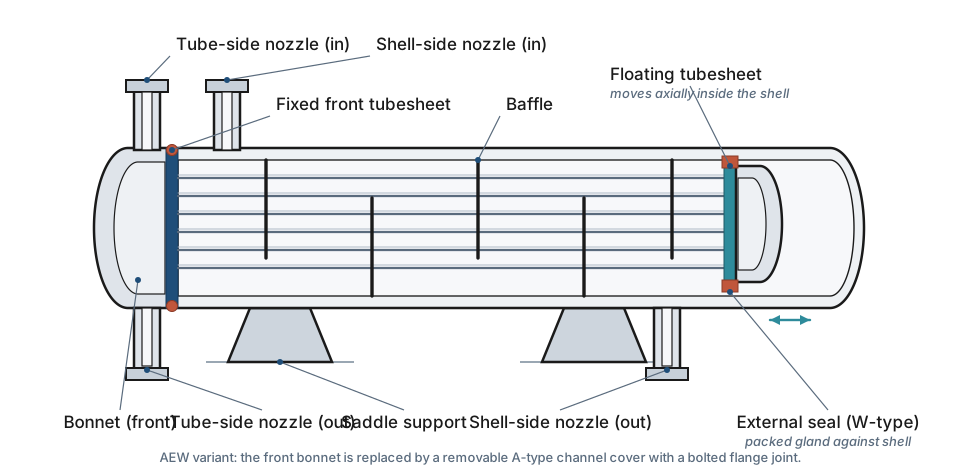
This is the configuration to choose when both fluids foul. Three maintenance actions become possible:
- pull the bundle out of the shell
- mechanically clean the tube interior with straight-tube rodding or pigging
- mechanically clean the shell side and the bundle exterior with hydroblasting
No other shell and tube configuration supports both cleaning paths.
The trade-off is cost. Floating head construction adds machined components and a sealed joint that a fixed tubesheet or U-tube design does not have. Industry references put the cost premium over fixed tubesheet construction at around 25 percent, with the exchanger size and the pressure class as the main variables.
Two configurations from the calculator apply: BEW and AEW.
Floating head with bonnet ends (TEMA: BEW)
BEW is a TEMA configuration code for a floating head exchanger that combines:
- a removable bolted front bonnet
- a single-pass shell
- a W-type externally sealed floating head at the rear
To reach the front of the bundle, the operator unbolts the front bonnet from the channel with the pipework disconnected. The rear floating head allows the bundle to move axially as the tubes heat or cool.
Choose BEW when
- both fluids foul. Mechanical cleaning is required on both sides over the design life.
- thermal expansion is significant.
- bundle replacement during the design life is a real possibility.
Avoid BEW when
- both fluids are clean. The cost premium is not justified.
- the service fits a U-tube and the tube-side fluid is clean. BEU or AEU will be cheaper.
Floating head with removable channel cover (TEMA: AEW)
AEW is a TEMA configuration code for a floating head exchanger with a removable A-type channel cover at the front and a W-type externally sealed floating head at the rear. AEW is recommended when both fluids foul and routine front-end access is needed without committing to a full pipework disconnect.
Choose AEW when
- both fluids foul.
- front-end inspection or chemical cleaning is part of the maintenance plan between full bundle pulls.
- the pipework run makes full disconnection slow or expensive.
Avoid AEW when
- both fluids are clean.
- routine front-end access is not part of the plan, and BEW delivers the same service for less.
Configuration summary table: floating head
The floating head summary table compares BEW and AEW attribute by attribute.
| Attribute | BEW | AEW |
|---|---|---|
| Tube interior cleaning | Pipework disconnect for front access. Straight tubes, mechanical cleaning supported. | In-place front access. Straight tubes, mechanical cleaning supported. |
| Shell-side cleaning | Bundle removable, full shell access | Bundle removable, full shell access |
| Bundle replacement | Bundle can be pulled and replaced | Bundle can be pulled and replaced |
| Thermal expansion | Accommodated by the floating head | Accommodated by the floating head |
| Relative cost | Highest in the four-configuration set. Around 25 percent above fixed tubesheet per industry references. | Slightly above BEW for the removable cover. |
| Typical services | Oil and gas processing, chemical processing, marine cooling, mineral processing where both sides foul | As BEW, where regular front-end inspection is expected |
Britannia Jahco designs, fabricates, installs, and tests floating head heat exchangers. Talk to the team about a floating head exchanger for your service.
Kettle reboilers (BKU)
In short. A specialised exchanger built for boiling or vaporising a shell-side fluid. The oversized shell creates a vapour space. Selection sits outside the fouling matrix.
A kettle reboiler is a specialised shell and tube exchanger built for boiling or vaporising a process fluid on the shell side. The shell is oversized compared to the bundle, often 50 to 70 percent larger in diameter, to create a free vapour space above the liquid pool. The process runs in three stages:
- saturated liquid enters the shell
- the liquid contacts the heated bundle and vaporises
- the vapour disengages at the top of the shell and exits
A weir inside the shell maintains the liquid level so the bundle stays submerged.
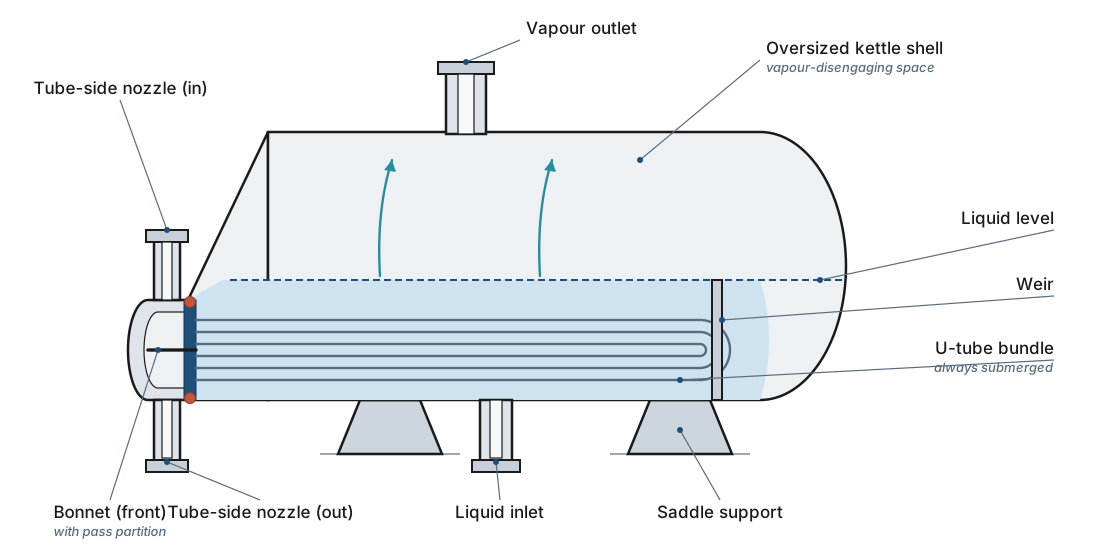
Kettle reboiler selection sits outside the fouling assessment. If the service involves boiling or vaporisation, a kettle is the right family. The fouling questions that drive the choice between BEM, AEN, BEU, AEU, BEW, and AEW do not apply in the same way to a kettle.
When to specify a kettle reboiler
A kettle reboiler is the right configuration when the service requires shell-side phase change with dry vapour exit. Three conditions point to a kettle:
- the service is partial or total vaporisation of a shell-side liquid
- a constant liquid level over the bundle is required for thermal control
- the vapour generated must be dry, so the oversized shell can let entrainment droplets settle out before the vapour leaves the unit
Typical kettle services include:
- distillation column reboilers
- refrigeration evaporators
- flooded chillers
- feed vaporisers
When to choose something else
A non-kettle configuration is preferred when the service does not require shell-side phase change or vapour-disengaging space. Three triggers route the design elsewhere:
- the service is sensible heating or cooling without phase change. A standard shell and tube configuration without vapour-disengaging space is more compact and cheaper.
- floor space is constrained. The oversized shell of a kettle reboiler has a larger physical footprint than an equivalent-duty unit without vapour-disengaging space.
- a thermosyphon reboiler is feasible. Thermosyphon arrangements use the density difference between liquid and a two-phase mixture to drive flow through a standard shell and tube exchanger, which avoids the kettle geometry entirely.
Configuration summary table: kettle reboiler
The kettle reboiler summary table lists the attributes of BKU.
| Attribute | BKU |
|---|---|
| Tube interior cleaning | Bundle removable. U-tubes typically used. U-bends not mechanically cleanable on the tube interior. |
| Shell-side cleaning | Bundle removable, full shell access including the vapour space |
| Vapour quality | Oversized shell gives a vapour-disengaging space, supports dry vapour exit |
| Thermal expansion | Accommodated by the U-bundle |
| Relative cost | Specialised geometry. Cost depends heavily on size and pressure class. |
| Typical services | Distillation column reboilers, refrigerant evaporators, flooded chillers, partial vaporisation duties |
Britannia Jahco designs, fabricates, installs, and tests kettle reboilers. Talk to the team about a kettle reboiler for your service.
Materials and when each one is right
In short. Material selection is the trade-off between capital cost and resistance to corrosion, erosion, and fouling. Australian work adds chloride exposure on coastal sites and high-purity service in regulated fabrication.
Material selection for a shell and tube heat exchanger is the trade-off between capital cost and three forms of long-term resistance:
- resistance to corrosion
- resistance to erosion
- resistance to fouling
The right choice depends on the chemical composition and temperature of both fluids, the design pressure and its wall-thickness implications, and the maintenance cycle the client is willing to fund. Australian work adds two specific drivers: chloride exposure on coastal and offshore sites, and high-purity service in regulated food and pharmaceutical fabrication.
Materials selection table
The materials selection table summarises common heat exchanger materials side by side.
| Material | Typical service | Relative cost |
|---|---|---|
| Carbon steel | Clean water, steam, non-corrosive light hydrocarbons | Baseline (1) |
| Stainless steel (304, 316) | Sanitary, hygienic, moderately corrosive process service | 3 to 5 times carbon steel |
| Duplex stainless steel (2205, 2507) | Chloride-containing brines, seawater cooling, high-pressure oilfield duties | 5 to 8 times carbon steel |
| Titanium (grades 1 and 2) | Seawater at elevated temperature, halide acids, severe corrosion service | 10 to 15 times carbon steel |
| Nickel alloys (Hastelloy, Inconel, Monel) | Mineral acids, aggressive chemical service, high-temperature combustion duties | 12 to 20 times carbon steel |
Material-by-material detail
Configuration by application
In short. Industry sectors converge on common configurations because typical fluids, fouling, pressure class, and cleaning regime drive similar trade-offs. Six industry contexts below.
Configuration by application is one of two axes for choosing a shell and tube configuration, complementing the service-based axis covered in Sections 3 to 8. Industry sectors converge on common configurations because four operating characteristics drive similar trade-offs:
- typical fluids
- fouling characteristics
- pressure class
- cleaning regime
This section walks through six industry contexts and the configurations that typically suit each.
Configuration-by-application table
The configuration-by-application table maps six industries to the configurations Britannia Jahco typically supplies.
| Industry | Typical fluids | Fouling profile | Typical configuration |
|---|---|---|---|
| Oil and gas | Crude, gas condensate, lube oil, glycol, sour service | Both sides foul under design life | Floating head (BEW, AEW), sometimes BEU |
| Chemical processing | Reactor feed, solvent, acid, alkali, organic stream | Variable, often heavy on one side | Configuration matches fouling pattern. Stainless or specialty alloy. |
| Power generation | Feedwater, condensing steam, lubricating oil, hydrogen cooling | Clean on closed loops, fouling on cooling water | Fixed tubesheet (BEM, AEN) for feedwater. Floating head for water-side fouling. |
| HVAC | Chilled water, hot water, glycol, refrigerant | Light to moderate on water circuits | Fixed tubesheet (BEM, AEN). Kettle reboiler (BKU) on flooded chillers. |
| Hospitals | Domestic hot water, clean steam, chilled water, refrigerant | Light, but hygiene drives specification | Fixed tubesheet (BEM, AEN) for water duties. Sanitary stainless for clean steam. |
| Food and beverage | Product fluid (milk, juice, wort), CIP solution, hot water, steam | Light, but CIP cycles drive cleaning frequency | Stainless, sanitary fittings. U-tube or floating head. |
Industry-by-industry detail
How Britannia Jahco engineers build your exchanger
In short. Britannia Jahco is an Australian shell and tube heat exchanger manufacturer covering design, fabrication, testing, and code-compliance certification.
Britannia Jahco is an Australian shell and tube heat exchanger manufacturer that supplies clients in Australia. The capability operates across four functions:
- thermal and mechanical design
- custom and OEM fabrication
- non-destructive testing and pressure testing
- code-compliance certification
Each function below links to its dedicated service page.
Thermal and mechanical design
Thermal and mechanical design is the engineering work that turns a client service into a manufacturable shell and tube exchanger specification.
Britannia Jahco uses Aspen Exchanger Design and Rating (EDR) to perform thermal and mechanical sizing on every custom shell and tube heat exchanger we design. Aspen EDR is the industry-standard software for rigorous heat exchanger modelling, built on over 40 years of HTFS research data and aligned to the current ASME BPVC Section VIII and 2023 edition standards that govern our fabrication work.
Britannia Jahco design team works to both the ASME Boiler and Pressure Vessel Code Section VIII Division 1 and the Australian Standard AS 1210 for pressure vessel design. AS 1210 is the basis for statutory pressure vessel registration in every Australian jurisdiction. Mechanical design covers three areas:
- thermal sizing, covering heat transfer area, tube count, and shell diameter
- mechanical sizing, covering pressure rating, tube wall, tubesheet thickness, and shell wall
- vibration analysis, for tube bundles in high-velocity service, with no-tube-in-window baffle layouts where needed
Custom fabrication
Custom fabrication is the workshop process that builds a designed exchanger from raw material through to a pressure-tested and certified unit. The Britannia Jahco Dandenong South workshop fabricates units from carbon steel through to specialty alloys, sized from compact lube oil coolers up to large process exchangers for oil and gas duties.
Custom fabrication covers three project types:
- new-build custom exchangers designed to the client service
- replacement bundles for an existing shell, built either to client-supplied drawings or to reverse-engineered drawings Britannia Jahco prepares from the original unit
- specialty fabrication, including TEMA Class R high-pressure construction, clad construction (titanium or alloy on a carbon steel base), and sanitary stainless construction for food, pharmaceutical, and hospital service
Non-destructive testing and pressure testing
Non-destructive testing and pressure testing are the inspection steps that confirm an exchanger meets its design specification before it leaves the workshop. Every Britannia Jahco unit ships with full inspection documentation.
The workshop runs four non-destructive testing methods:
- eddy current testing, for tube-wall integrity
- ultrasonic testing, for weld quality and material thickness
- radiographic testing, for weld inspection
- magnetic particle testing, for surface and near-surface defect detection
Hydrostatic pressure testing follows the design code, typically 1.3 to 1.5 times design pressure depending on the applicable code. Pneumatic testing applies where hydrostatic testing is not feasible, with the appropriate safety controls.
Code compliance and certification
Code compliance and certification is the documentation process that proves an exchanger meets the standards it claims and that the design and fabrication followed them. Every Britannia Jahco unit carries compliance against four code families:
- AS 1210, the Australian standard for pressure vessels and the basis for statutory registration in every Australian jurisdiction
- ASME Section VIII Division 1, the international pressure vessel construction code
- TEMA Standards, for shell and tube specific mechanical detail and construction class (R, B, or C)
- API 660, for petroleum and natural gas industry units
Where the service involves explosive or hazardous atmospheres, units carry the relevant Australian hazardous-area certification (AS/NZS 60079 series). ISO 9001 quality management certification covers the workshop and the documentation process end to end.
Common configuration-selection mistakes Britannia Jahco sees on quote requests
In short. A configuration-selection mistake is an early specification decision that costs more later.
A configuration-selection mistake is a specification decision an engineer or estimator makes early that costs more later. The consequences show up in one of three forms:
- poor exchanger performance through the service life
- expensive or impossible maintenance cycles
- scrapped equipment
FAQ
In short. Frequent questions engineers and procurement teams ask us about shell and tube heat exchanger configuration.
These are frequent questions engineers and the procurement team often ask us about shell and tube heat exchanger configuration.
Request a quote
In short. The next step after settling on a configuration is a quote request. Standard quotes turn around in roughly two weeks.
The next step after settling on a configuration is a quote request. The Britannia Jahco engineering team turns standard quotes around in roughly two weeks. Complex specifications take longer.
Three pieces of information get the process started:
- the service specification with flows, temperatures, pressures, and fluid types
- any drawings you have from the original unit or from preliminary design
- the configuration you have in mind, based on this guide or the calculator
The Britannia Jahco engineering team are the technical leads on shell and tube heat exchanger projects. Call the team for a configuration discussion before sending a formal quote request. The conversation usually saves time on both sides.
/* WS Form 5 helpers: comment 38 (start on first tab) + comment 50 (smooth-scroll on tab nav). */ (function(){ function form(){ return document.querySelector(“form.wsf-form”); } function resetToFirstTab(){ var f=form(); if(!f) return; var first=f.querySelector(“.wsf-group-tab a”); var active=f.querySelector(“.wsf-group-tab.wsf-tab-active a”); if(first&&active&&first!==active){ first.click(); } } function scrollToForm(){ var f=form(); if(!f) return; var top=f.getBoundingClientRect().top+window.pageYOffset-110; window.scrollTo({top:top<0?0:top,behavior:"smooth"}); } document.addEventListener("wsf-rendered",function(){ resetToFirstTab(); }); if(document.readyState!=="loading"){ setTimeout(resetToFirstTab,700); } else { document.addEventListener("DOMContentLoaded",function(){ setTimeout(resetToFirstTab,700); }); } /* comment 50: any tab click or Previous/Next navigation scrolls the form into view. */ document.addEventListener("click",function(e){ var f=form(); if(!f) return; var t=e.target.closest(".wsf-group-tab a, button.wsf-button, .wsf-button"); if(t && f.contains(t)){ setTimeout(scrollToForm,60); } },true); })();